
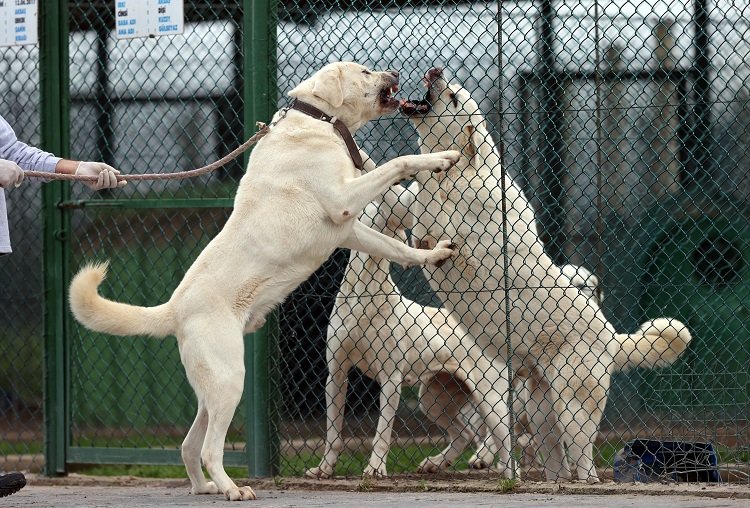
- Kangal or Kangal dog: Its native homeland is Turkey, and it is called the Anatolian shepherd. It lives abroad as a herd guard and adapts to all weather conditions. It lives a nomadic life, as it is considered a wonderful guard and safety dog. It is a good friend for family members and children and is not suitable for living inside apartments. They make good companions for runners, [1] [2] and are not suitable for the novice breeder.
- The length of the Kangal dogs: These dogs are long, as the length of the male Kangal dog reaches more than 81 cm, while the length of the female is about 76 cm.
- Weight of Kangal dogs: These dogs are heavy, as the average weight of males when fully grown is about 65.7 kilograms, while females weigh 54 kilograms.
- Characteristics of Kangal dogs: Large-sized dogs, one of the healthiest dog breeds. It is distinguished by its large head and a dark-colored area around its mouth, nose, and ears, and its tail curled to its back. It also has short, thick fur, and has white markings on its toes, chest, and chin. It also has a high physical fitness. [ 2] [4] Its fur is double, and the length of the fur ranges from 3 to 7 cm, and it is thicker in winter than in spring.
- Average lifespan of Kangal dogs: The average lifespan of these dogs is between 12 and 15 years. They are in good health and do not suffer from fatal diseases. Their longevity depends on the nutritional pattern and the extent of exercise.
Table of Contents
Characteristics and behavior of Kangal or Kangal dogs
Kangal or Kangal dog personality traits
Each type of dog is characterized by its own personal characteristics, including:
- It is considered one of the medium barking dogs.
- He needs large spaces to roam daily.
- It needs a lot of exercise.
- They are considered alert and protective dogs.
- They are patient and loyal dogs.
- It is characterized as one of the fastest dogs, as its speed reaches 56 km/hour.
- They are considered intelligent and free-thinking dogs.
- It has a bite force that is considered one of the strongest in the world.
- They are considered difficult dogs to train, as they are considered dogs with an independent personality.
- They are considered very organized and balanced dogs.
- You have the courage to stand up to the deadliest animals in the world such as; Raccoons, wolves, bears, foxes, and hawks, and he can also defeat them.
- It is suitable for living on farms or houses with large gardens.
- It is preferable to deny access to enemies rather than attack them.
- They are considered obedient and calm dogs.
- He tends to form a strong bond with his breeder.
- They tend to dig proficiently, and they also tend to chew hard.
Tips for dealing with Kangal or Kangal dogs
When dealing with Kangal or Kangal dogs, the following tips must be followed:
- They must be well trained, as they are defensive, strong and can be dangerous.
- When the dog feels that his handler’s personality is weak or not leadership, he will take control and assume leadership.
- They must be trained from a young age to accept strangers, other animals, and children.
- Her training begins from the age of a few weeks until she reaches maturity.
- It is best to give puppies toys to chew.
- Obedience and agility exercises should be avoided with these dogs.
- A dog should not be left in public places without a collar, as its behavior cannot be completely trusted.
- The traditional training followed with other dogs is not useful, as they cannot be trained to guard the flock as this is something innate to them, so the trainer’s role here is only supervision.
- You must focus on the positive motivational reward when training a Kangal dog, as anything other than that may lead to a negative result.
- It must be occupied with certain functions, such as watching children or other pets.
Nutrition of Kangal or Kangal dogs
Essential foods for Kangal dogs
It is necessary to pay attention to the following points when offering food to the dog:
- Kangal puppies can be given small pieces of meat and soft cartilage bones by adding them to the cooked broth.
- You can serve a meal consisting of barley flour, hot water, yogurt, and nutritional supplements, all of which form an easy-to-eat paste.
- When a dog reaches adulthood, one meal per day should be divided into one-third of meat, one-third of carbohydrates and vegetables, and one-third of water.
- He can eat cooked eggs, vegetables, fruits, and cheese, but they should not constitute more than 10% of the daily ration.
- It must be provided with an appropriate amount of water daily.
- It is preferable to provide food rich in calcium
- She should be given raw meat at times, as the best food for her is raw food.
Foods that are not suitable for Kangal or Kangal dogs
The following items must be avoided, which pose a risk to his health, including:
- Avoid chocolate, tea, and coffee.
- Avoid raisins and grapes.
- Avoid onions, garlic, and chives.
- Avoid salty foods.
- Avoid chicken and turkey bones.
The number of meals suitable for Kangal dogs
The following must be adhered to when providing food to a Kangal or Kangal dog :
- When a dog matures, he should be given one meal a day, but some prefer two light meals to one heavy meal.
- Puppies eat 4 meals a day during the age period from 6 weeks to 3 months.
- Puppies eat 3 meals a day during the age period from 3 to 6 months.
- Puppies eat two meals a day during the age period from 6 to 12 months.
- Adult dogs need between 2,600 to 3,500 calories per day for males, while females need from 2,100 to 2,800.
- Male puppies need 3,900 to 4,800 calories, and female puppies need 3,000 to 4,100 calories.
- The amount of food depends on the size and age of the dog, but a dog often needs 30 calories for every 0.45 kilograms of its weight.
Health of Kangal or Kangal dogs
The most common diseases that affect Kangal or Kangal dogs
These dogs enjoy good health, but in some cases, they suffer from some health problems, including:
- Entropion: It is a deformity of the eyelid that results in the eyelid turning inward, which leads to hair rubbing against the eye, causing inflammation and discomfort. It can be observed by constantly watering the eye and staring at things. It can also be treated through surgery to correct the eyelid.
- Hip dysplasia: It is a common hereditary disease in large dogs, where the hip joint grows abnormally and begins to occur in puppies. The matter worsens as the dog grows and ages until lameness appears clearly. It can be treated with anti-inflammatory medications and through surgery to correct the condition. The joint.
- Lipoma: It is a fatty mass that grows on the chest or abdomen, directly under the skin. Although it increases in size very significantly over time, it often does not cause any pain and remains benign, and a veterinarian can remove it.
- Juvenile disease: a disease that affects puppies, as they develop fever and shivering in all parts of the body, and the muscles of the upper lip suffer from involuntary spasms, and walking becomes irregular, and it poses a risk of up to death by 20 to 50%, and it can be prevented through a vaccine given to puppies when they are young. At the age of 6 weeks, puppies must be protected from cold drafts and humidity and provided with healthy food
Maintaining the health of Kangal or Kangal dogs
To avoid health problems that the dog is likely to suffer from, the following must be done:
- You should pay attention to her eyelids when bathing, examine them, and look for signs of eyelid inversion or inflammation.
- You need prolonged daily exercise of up to two hours.
- The dog’s vaccination and immunization schedule must not be overlooked to maintain its health.
- These dogs’ coats should be brushed two to four times a year; To maintain the health of the coat.
- The dog’s teeth must be cleaned constantly and a special diet must be given; To maintain dental health.
Other tips on raising Kangal or Kangal dogs
When you acquire a Kangal or Kangal dog, you must take care of it appropriately by:
- They are considered dogs with a large appetite, so you must pay attention to the amount of food they eat.
- Dogs’ coats should be combed frequently and extensively during shedding season; This is to remove fallen hair.
- She trims her nails once a month.
- This dog does not need to brush its teeth, and it is enough to pay attention to its diet and periodically visit the veterinarian.
- It is enough to bathe a Kangal dog 4 times a year, but if the fur becomes dirty, it must be bathed.
- When raising these dogs, there must be high fences and deep, strong foundations to prevent them from jumping or digging.
